
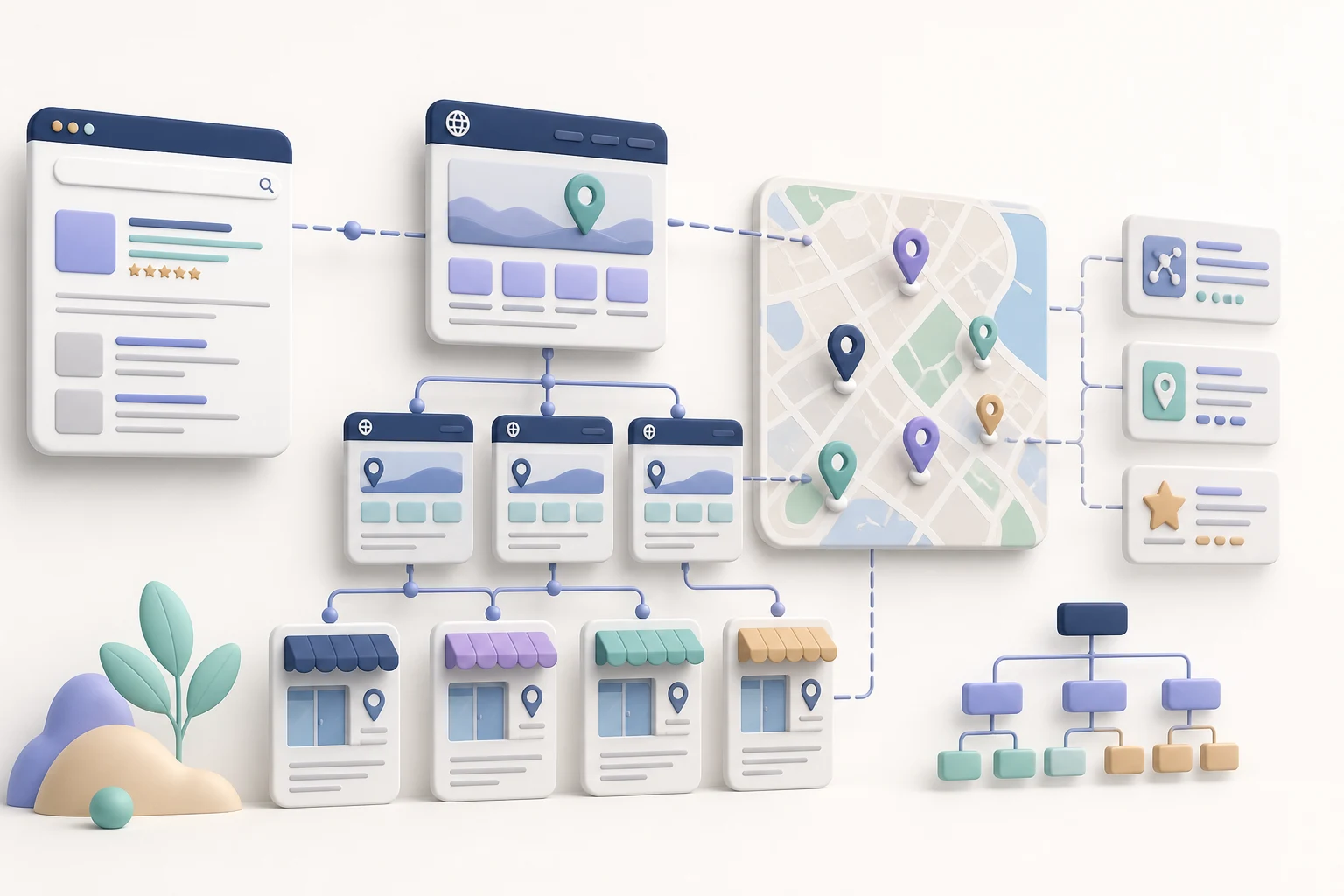
The short answer: a map interface alone is not a local SEO strategy. Search engines need crawlable URLs, useful location-specific content, consistent internal links, and accurate structured data. Shoppers still need a fast map or list experience. Strong locator SEO designs those as complementary layers.
Separate the search landing layer from the locator interface
A visitor arriving from a brand product page wants an interactive answer now. A search engine evaluating a location result needs stable, indexable information associated with a URL. One interface can support both goals, but it should not assume that a JavaScript map with dynamically loaded pins automatically creates useful search pages.
A common architecture has three layers:
- A crawlable locator hub linked from normal site navigation.
- Region, city, or individual location pages where the content justifies them.
- An interactive map-and-list experience for nearby discovery.
Do not create thousands of near-empty city pages simply to target place names. Each indexable page should have a real purpose and accurate, distinctive information.
Build a logical URL hierarchy
Google recommends linking from menus to category pages and then to detail pages so both people and crawlers can discover the hierarchy. For a location network, that might look like:
/where-to-buy//where-to-buy/united-states//where-to-buy/california//where-to-buy/california/huntington-beach/
The exact pattern matters less than consistency. Use the same preferred URL in internal links, canonical tags, and the sitemap. Avoid generating multiple URLs for the same location through tracking parameters, map states, or inconsistent slugs.
Independent dealer networks require judgment. A brand may not control enough unique information to justify a full page for every dealer. In that case, useful region pages plus a robust locator may be better than thin dealer-detail pages.
Make important content available without map interaction
Search engines can render JavaScript, but discoverability should not depend on dragging a map, entering a ZIP code, granting location access, or clicking a marker. Important locations and detail pages need standard crawlable links using anchor elements with href attributes.
For users, provide a synchronized list view beside or below the map. The list is easier to scan, use with a keyboard, and understand on small screens. It also provides a natural place for business name, address, hours, phone, directions, partner type, and relevant product or service information.
Use LocalBusiness structured data accurately
Google describes structured data as a standardized format for classifying page content. LocalBusiness markup can express details such as business name, address, phone, hours, URL, and geographic coordinates.
Apply markup to the page about that specific location and keep it consistent with the visible content. Do not mark up a list of independent dealers as if every business were a location owned by the brand. Schema is a description of reality, not a lever for manufacturing ownership.
Other useful types may include:
Organizationfor the brandBreadcrumbListfor the page hierarchyProductorProductGroupon actual product pagesItemListfor a genuine list of locations or resources
Structured data can improve machine understanding, but it does not guarantee a rich result or ranking.
Give each indexable page enough useful information
Location pages should answer the questions a customer would reasonably ask:
- What is this location and what relationship does it have to the brand?
- Where is it, and how can the customer contact it?
- When is it open?
- Which services, product categories, or partner roles apply?
- Is inventory shown, and how fresh is it?
- What is the next action: directions, call, retailer website, or product result?
Avoid generic paragraphs with only the city name swapped. Those pages add little value for people and create a maintenance burden.
Treat accuracy as an SEO requirement
Incorrect hours, duplicate locations, broken seller links, and closed dealers damage the customer experience even if the page ranks. Define a source of truth and a correction process for every field. If sellers can manage their records, decide which changes publish automatically and which require review.
Keep sitemap entries aligned with real, canonical pages. Remove or redirect retired location URLs deliberately. Google and Bing both use sitemaps as discovery signals; Bing also recommends current sitemaps and IndexNow to communicate additions, changes, and removals quickly.
Handle geolocation without hiding the site
Geolocation can improve ordering, but it should be optional. Provide manual city, postal code, or country search. Do not redirect every visitor based solely on IP-derived location, and do not prevent crawlers or privacy-conscious users from reaching the underlying pages.
When a visitor denies permission, preserve the interface and explain the manual alternative. A denied browser prompt is not an error state.
Measure organic and locator performance together
SEO reporting should connect the landing page with the next action. Useful measures include:
- Organic entries to locator and location pages
- Search queries and pages that earned impressions
- Locator searches and no-result rates
- Clicks to seller sites
- Calls and direction requests
- Performance by device and market
- Accuracy issues reported or corrected
Do not treat map opens as the final conversion. The locator exists to move the visitor toward a useful partner action.
A store-locator SEO checklist
- Stable, descriptive, canonical URLs
- Standard crawlable links from hub to detail pages
- Unique, useful, visible location information
- Map plus accessible list view
- Correct LocalBusiness and breadcrumb markup where applicable
- XML sitemap coverage
- Manual search when geolocation is unavailable
- Fast mobile rendering and no horizontal overflow
- A process for closures, duplicates, and broken links
- Analytics connecting organic landings to seller engagement
Omacro supplies the customer-facing seller and dealer locator experience; any indexable location-page strategy should be coordinated with the brand’s website architecture and SEO team. See the dealer locator UX checklist for the interaction layer.