
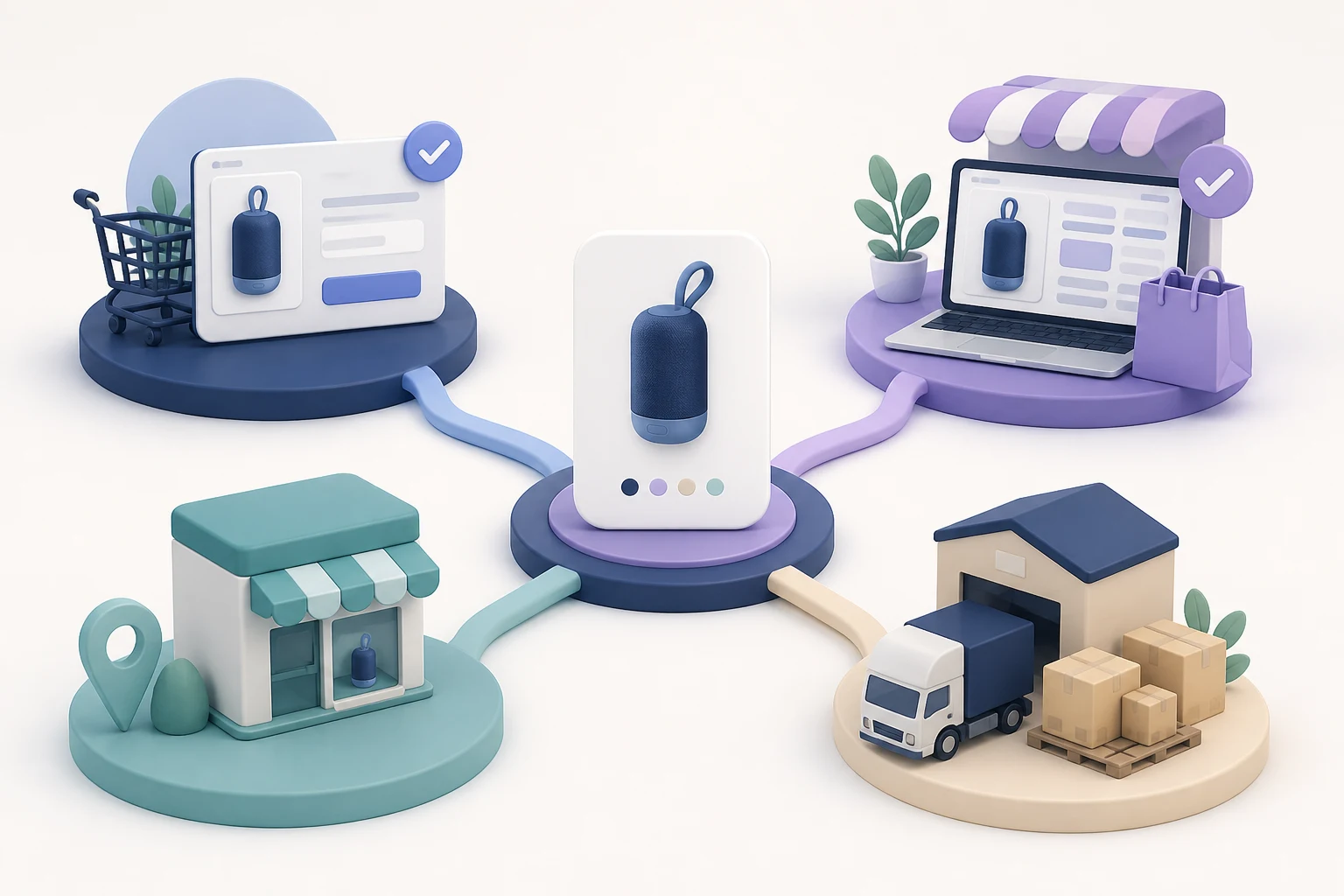
The short answer: direct commerce and dealer networks can share one purchase journey when the brand defines transparent eligibility, gives each path a legitimate role, and measures customer intent without pretending every click is a completed sale. The interface should help the shopper choose—not quietly rig the outcome.
Start with customer situations, not channel labels
A shopper may prefer direct purchase because the product is exclusive, configurable, or supported by a brand promotion. Another may need local advice, installation, immediate pickup, financing, a demonstration, or a long-standing dealer relationship. An international buyer may need an authorized distributor rather than either domestic option.
Map those situations:
- Standard product available through many sellers
- Direct-exclusive configuration
- Product requiring consultation or installation
- Urgent local purchase
- Online comparison shopper
- Trade or wholesale buyer
- International market with distributor coverage
- Region with no approved local seller
Then decide which paths are valid for each situation.
Use one clear entry point
A unified “Where to Buy” or “Buying Options” action can present:
- Buy direct
- Buy from authorized online retailers
- Find nearby dealers
- Contact a regional distributor
- Find an installer, service center, or rental provider
The brand can customize the label, but the result should make the choice understandable. Avoid separate buttons scattered across the page if their relationship is unclear.
Define fair result rules
Write the rules before designing the cards.
- When is direct purchase eligible?
- Are options ranked by exact product match, location, inventory, authorization, service capability, or another factor?
- Are online and local results shown together or in distinct sections?
- How are sponsored, preferred, or strategic partners identified?
- What happens when the direct option is out of stock?
- How are distributor territories applied?
- Which options appear for products that require professional installation?
Consistency matters. If channel partners believe the brand’s locator always places direct commerce first regardless of customer need, the interface can erode trust even when all options technically appear.
Make each path useful
Direct
Link to the exact product and selected variant. Preserve configuration, campaign, and market context. Be clear about stock, shipping, and support.
Authorized online retailer
Link to the correct retailer product page. Remove broken or mismatched offers. Distinguish retailers from third-party marketplace sellers when the policy requires it.
Local dealer
Show distance, address, phone, hours, directions, and the confidence of product availability. “Carries the brand” should not be presented as “in stock.”
Distributor or specialist
Explain the partner role and provide the right contact action. Territory and market eligibility can matter more than physical distance.
Share value with the channel
A locator can be a channel program, not just a website component. Sellers gain qualified traffic from brand product pages and can receive clearer engagement reporting. Brands gain visibility into which products, partners, and markets attract action.
Useful seller-facing practices include:
- A free or low-friction way to claim and update listing information
- Clear requirements for authorization and product links
- Transparent result eligibility
- A correction process
- Reporting that distinguishes clicks, calls, directions, and shares from confirmed sales
- Regular communication about data quality expectations
Handle assortments and exclusives deliberately
Not every seller carries every variant. Product matching should connect exact retailer offers where possible and use honest fallbacks where it cannot.
For exclusives:
- Identify the eligible channel or seller set explicitly
- Avoid showing unavailable alternatives as exact matches
- Keep market and date restrictions current
- Provide a useful fallback when the exclusive path is unavailable
Measure the combined journey
Use a shared event model across purchase paths:
- Direct product-page click
- Authorized retailer product click
- Dealer directions
- Dealer call
- Distributor contact
- No-result search
- Product, market, and partner attached to the event
Compare engaged sessions and result coverage, not only raw click totals. Direct conversion data and off-site dealer engagement are different evidence types. Report them together when useful, but do not pretend they are equivalent.
Look for strategic gaps:
- Products with strong demand but few valid seller options
- Markets where direct dominates because channel coverage is weak
- Dealers receiving impressions but little action
- High local intent with no inventory signal
- International traffic falling into domestic results
Create governance for conflict
Assign owners for result ranking, eligibility, direct promotions, dealer authorization, suppression, territory, and exception handling. Review changes that alter channel exposure before they launch.
The locator should execute approved channel strategy. It should not become the place where unresolved channel strategy is improvised in code.
How Omacro fits
Omacro can combine configurable Buy Now, dealer, distributor, installer, service-center, and rental-provider actions in one experience. It supports online and local seller results, international distributor paths, product matching, and engagement reporting by product, seller, and location. Explore the platform for brands or book a demo to map the options to your channel model.